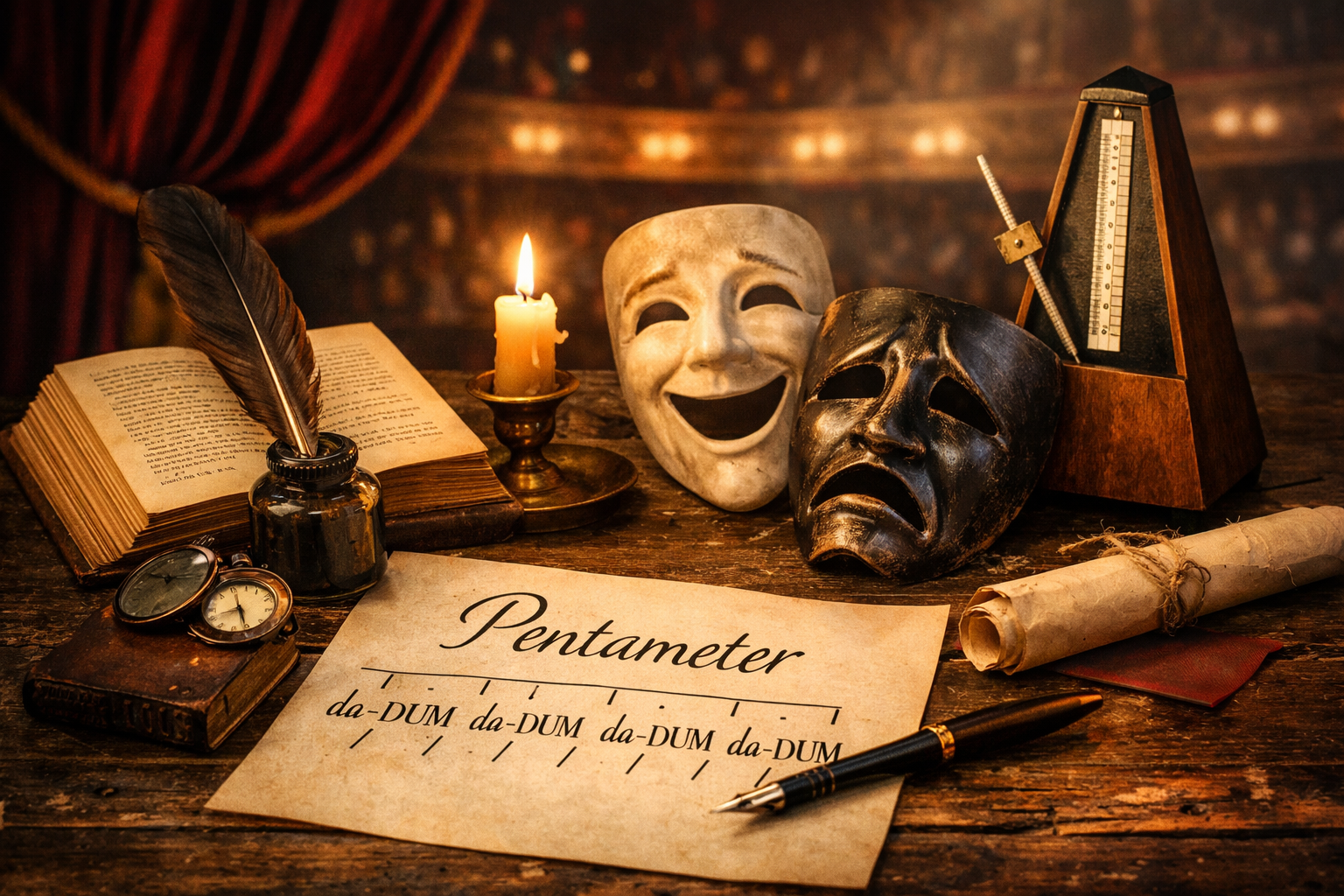
In the study of poetry and performance, few terms are as frequently invoked—and as imperfectly understood—as pentameter. For students of literature, it is a metrical pattern on the page. For actors, it is a living pulse in the breath. For audiences, it is often the invisible architecture that makes language feel elevated, musical, and emotionally resonant.
This article introduces pentameter in clear terms and explores its central role in recitation and acting, particularly within the English dramatic tradition.
Table of Contents
What Is Pentameter?
The word pentameter derives from the Greek penta (five) and metron (measure). In poetry, it refers to a line composed of five metrical feet. A foot is a unit of rhythm consisting of a particular arrangement of stressed and unstressed syllables.
Pentameter does not describe the stress pattern itself; rather, it describes the number of feet. The type of foot determines the rhythm.
In English poetry, the most common form is iambic pentameter.
Understanding the Iamb
An iamb is a metrical foot consisting of:
an unstressed syllable followed by a stressed syllable
da-DUM
For example:
re-LIEVE
be-LONG
the SUN
When five iambs are placed in sequence, we have iambic pentameter:
da-DUM | da-DUM | da-DUM | da-DUM | da-DUM
A classic example from William Shakespeare is:
Shall I compare thee to a summer’s day?
Scansion (marking stresses) reveals the pattern:
shall I | comPARE | thee TO | a SUM | mer’s DAY
Though natural speech often bends the pattern slightly, the underlying five-beat structure remains.
Why Pentameter Became Central to English Drama
English is a stress-timed language, meaning rhythm depends on stressed syllables occurring at roughly regular intervals. Iambic pentameter closely mirrors natural English speech—yet refines it.
During the Renaissance, dramatists such as Christopher Marlowe and later William Shakespeare recognised that iambic pentameter offered:
- Elevated expression without artificiality
- Flexibility within structure
- A rhythm conducive to emotional speech
The result was blank verse—unrhymed iambic pentameter—which became the dominant form of serious English drama.
Blank verse allowed characters to speak with grandeur while retaining dramatic immediacy.
Pentameter as a Breath Structure
For actors, pentameter is not merely an abstract pattern. It is a breath unit.
A line of pentameter typically aligns with a comfortable breath span. This is not accidental. The human breath naturally supports roughly five stresses before renewal. Thus, pentameter:
Organises thought
Shapes emotional delivery
Encourages vocal support
Creates momentum
When actors ignore the metre, lines may feel flat or rushed. When they honour it, speech gains musicality and clarity.
The Actor’s Relationship with Pentameter
1. It Reveals Meaning
Shakespeare and his contemporaries used metrical regularity—and irregularity—to signal shifts in thought and emotion.
A broken line may suggest:
- Emotional disturbance
- Urgency
- Interruption
- Loss of control
For instance, a character who abandons pentameter for prose often signals a change in status, mood, or psychological state.
Actors trained in verse learn to notice:
- Shared lines (where two characters complete a single pentameter line)
- Inversions (a stressed syllable at the beginning)
- Extra syllables (feminine endings)
- Caesuras (mid-line pauses)
Each variation carries interpretative significance.
2. It Encourages Forward Momentum
The iamb moves forward naturally because the stress lands at the end of each foot. This creates propulsion:
da-DUM | da-DUM | da-DUM | da-DUM | da-DUM
The stress at the end of the line pulls the voice onward. Skilled actors ride this energy rather than resisting it.
This forward drive is particularly important in:
- Soliloquies
- Rhetorical speeches
- Moments of persuasion
- Argumentative exchanges
Pentameter supports thought unfolding in real time.
3. It Supports Emotional Clarity
Contrary to the assumption that metre restricts expression, pentameter can heighten emotional truth.
Why?
Because structure frees the actor from uncertainty. The rhythm provides:
- A spine
- A pacing guide
- A vocal map
Within that structure, emotion becomes more precise. The actor does not “feel first and speak second”; rather, the thought, breath, and feeling arise together.
Pentameter and Recitation
Recitation, whether in academic settings or formal performance, benefits enormously from metrical awareness.
Common Mistake: Sing-song Delivery
Inexperienced readers often exaggerate the da-DUM pattern mechanically:
shall I comPARE thee TO a SUMmer’s DAY
This produces artificiality.
The goal is not to chant the metre, but to allow it to underpin natural speech. Good recitation:
- Respects stress without over-marking it
- Preserves sense over rhythm
- Uses punctuation as guidance
- Allows variations to emerge organically
Pentameter should be felt, not forced.
Blank Verse vs Prose in Performance
In Shakespearean drama, shifts between verse and prose are meaningful.
- Verse often indicates nobility, reflection, heightened thought.
- Prose may suggest informality, madness, humour, or social equality.
An actor who recognises the difference adjusts:
| Feature | Verse | Prose |
|---|---|---|
| Rhythm | Structured | Flexible |
| Breath | Measured | Variable |
| Tone | Elevated | Conversational |
| Thought | Formal | Immediate |
Pentameter becomes a psychological and social signal within the text.
Feminine Endings and Emotional Nuance
Many pentameter lines include an extra unstressed syllable at the end:
To be, or not to be, that is the question.
Here, the additional syllable softens the line’s conclusion.
Such “feminine endings” often indicate:
- Reflection
- Uncertainty
- Emotional vulnerability
- Ongoing thought
Actors attentive to these subtleties discover richer interpretative possibilities.
Shared Lines and Dramatic Tension
In dialogue, two characters may complete a single pentameter line together. This creates rapid exchange and heightened tension.
For example:
Character A:
I’ll meet thee at the marketplace at noon—
Character B:
And there we shall resolve this matter fully.
If their combined speech completes five stresses, the shared rhythm reinforces dramatic connection.
For actors, this demands acute listening and precise timing.
Pentameter in Modern Acting Training
Contemporary drama schools in Britain continue to teach verse-speaking techniques rooted in pentameter awareness.
Training typically includes:
- Scansion practice
- Breath control exercises
- Textual analysis
- Linking metre to intention
- Speaking verse while maintaining naturalism
The aim is not antiquarian fidelity, but living speech.
When pentameter is honoured without rigidity, it becomes:
- Conversational yet elevated
- Structured yet spontaneous
- Musical yet psychologically truthful
Pentameter Beyond Shakespeare
While Shakespeare is the most celebrated practitioner, pentameter appears widely in English poetry, including the works of:
- John Milton
- Alexander Pope
- William Wordsworth
In each case, pentameter adapts to different tonal and thematic demands—epic, satirical, reflective.
Actors performing Romantic poetry, epic narration, or classical verse must approach pentameter with similar attentiveness.
The Psychological Effect on Audiences
Even when audiences are unaware of metre consciously, they respond to it subconsciously.
Pentameter creates:
- Expectation and fulfilment
- Musical balance
- Emotional rhythm
- Cognitive ease
It provides a subtle pleasure rooted in pattern recognition.
When a line breaks the pattern, the audience senses disruption—even if they cannot articulate why.
Thus, metre becomes a dramatic tool.
Pentameter as Living Architecture
Pentameter is not merely a technical term in prosody. It is the invisible architecture of much of English dramatic speech.
For reciters, it offers structure and musicality.
For actors, it provides breath, intention, and emotional momentum.
For audiences, it shapes perception and feeling.
At its best, pentameter is not heard as pattern but experienced as inevitability—language moving with purpose, shaped by rhythm, yet alive with thought.
To master pentameter is not to imprison speech in metre. It is to discover how rhythm, meaning, and emotion intertwine—so that verse speaks not as relic, but as living voice.