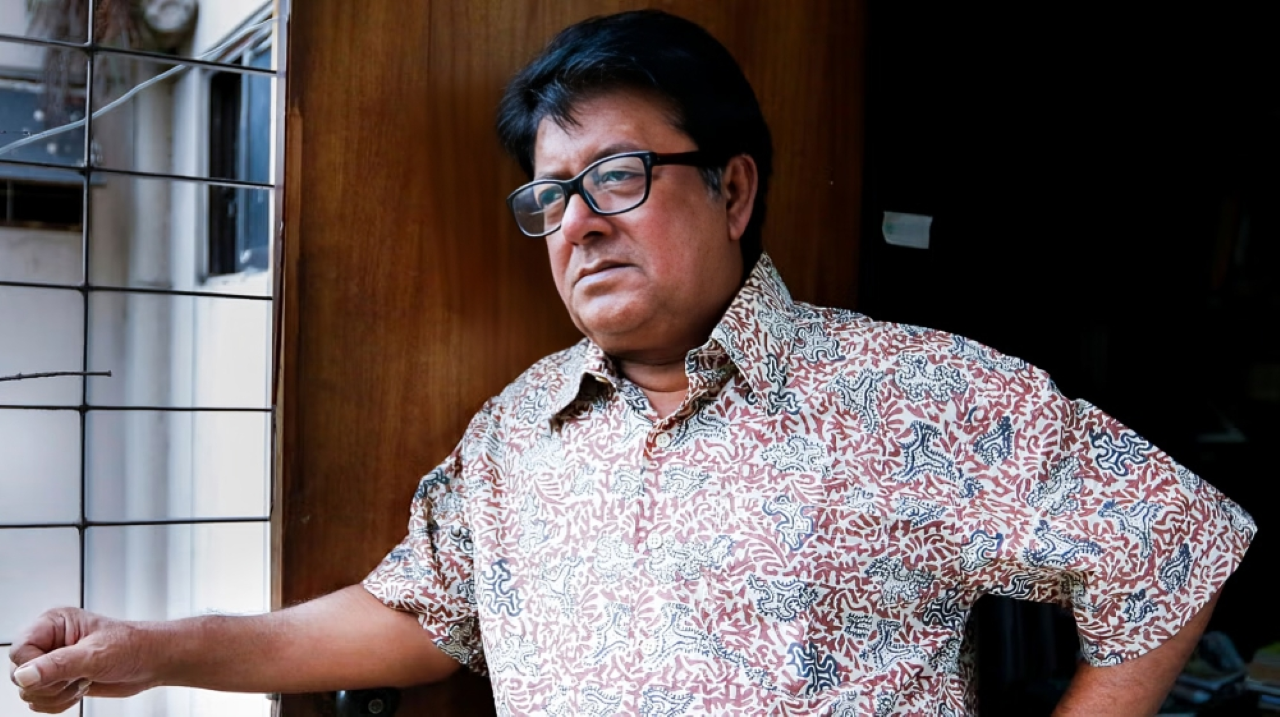
Solaiman had a pair of eyes. Commonly, it is said that the eyes are dreamy, but in his case, they were not. His eyes were melodic and musical. It seemed as though, with the flutter of his eyelids, a song would emerge from his lips, and through his eyes, he could create music.
Solaiman’s voice was moist. In that moist voice, musical notation would effortlessly emerge. These notations later manifested in his dialogues.
He was born in Assam. The soil of Assam is humid and cool. Whether it was from this very soil that music found a home in his heart, we do not know. A young boy, full of songs, later ventured into theatre. In between, a storm of politics tried to scatter him. According to his friends, the music-obsessed boy once became a rebellious figure in politics as well.
But the politics he embraced was not one of opportunism. It was the politics of the liberation of the common people. However, when this politics fell into the winds of misguided paths, Solaiman’s heart was torn. He fully returned to the realm of art. Even within the world of music, he confined himself to theatre.
Theatre is an all-consuming art form. It disrupts everything. On one hand, there is the constant search for art, its contemporaneity, and on the other, there is the organisation. Bringing these two together is truly challenging. A painter works alone, a singer can sing alone, and a poet can engage in their craft in solitude. But theatre is not a solitary endeavour. Rather, it demands coordination. A kind of society is formed. It is this organisational power that gives birth to a unified art. Yet, in practising this art, a certain arrogance also emerges.
For someone like Solaiman, who could create music with his eyes and build dialogues, how safe was it for him to work in such an organisation?
Yet, he managed to do so. One could say that a group would form around him. In an incomplete life, he managed to lead many creative organisations. His journey began with Kalantor, followed by Padatik Natya Sangshad, Dhaka Padatik, Annyadal Natya Sampraday, Theatre Art, and Theatre Art Unit. This, too, was in accordance with the fate of Bengali theatre. From Girish’s time to Ajitesh Bandyopadhyay, no founding director has ever remained with their group. They had to change groups or form new ones. The sustained organisation of Bengali theatre has always been unstable.
Since Solaiman’s roots were embedded in musical notation, it is evident that he had a strong inclination towards musical productions. His interest in music-infused theatre was intense. He felt most at ease in that space. From there, he entered the origins of Bengali theatre, where music had once completely dominated. Even popular Bengali songs were often derived from theatre. Thus, in the Western style (even though Solaiman had not yet been to the West), he was creating musicals suited to this land.
However, this was not a musical drama, nor a dance drama. It was pure acting using the language of the body and choreography. It was not a musical demonstration, but rather the use of theatre. In doing so, he sought both Eastern and Western theatrical resources. When his play’s hints were being performed, a stir was created. On one side, there was the use of music, sharp dialogues, collective and individual performances, and on the other, there was the timely selection of subjects.
Even a small street play like Khapa Paglar Pachal once created a storm in our theatrical scene. Solaiman’s performance was quite remarkable there. Solaiman worked in various aspects of theatre—writing, directing, acting, music direction, composing, and organising.
In his writings, a certain preference for farce is always noticeable. Within that farce, one could easily find both entertainment and meaning.
Solaiman was fiercely opposed to religious bigotry, communalism, and narrow-mindedness. Through satire, mockery, and sharp dialogue, he sought to tear these ideologies apart. In this regard, he was uncompromising. In the realm of theatre in this country, he boldly declared war against such tendencies with unparalleled courage. His works exemplify how music can powerfully contribute to satire, with nearly every play he created demonstrating this.
Just as he was vocally against authoritarian military juntas, he spared no criticism of electoral farces. In his play Election Caricature, he presents Rafiq Uddin B.A. to highlight the electoral weaknesses in our democratic system. Reading Election Caricature today, one might feel that its relevance has only increased manifold. The democratic system in our country seems to be steadily faltering, and the electoral process may well be a major factor behind this decline—a truth Solaiman recognised long ago.
Discussing just one of Solaiman’s plays would require a vast expanse of space. Perhaps, in the future, a researcher will undertake this task. However, as an avid admirer, some discussions of his works are certainly relevant. Goni Mia is one such extraordinary composition and production of Solaiman’s. From the village to the city, from feudalism to capitalist enterprise, and the deep entrenchment of religious beliefs—he presents all these with a masterful nuance.
The traditional beliefs of Heaven and Hell are given a strange musical twist. Solaiman’s use of the chorus is unparalleled. His expertise in bringing the chorus to life is truly remarkable. In Goni Mia, we encounter a peculiar dialectic. On one hand, there’s his idealism, his integrity towards the education system, while on the other, there’s the desire to reclaim the lost wealth of his ancestors. Most strikingly, his veins are filled with feudalism, creating a character that could only be crafted by a politically conscious artist. Goni Mia stands as living proof of how idealism can be destroyed by personal desire.
Even our traditional folk music is used with true modernity here. At one point, Goni Mia says, “The world is greedy, taking advantage of others while stealing their gain, while those greedy for the afterlife forsake worldly pleasures and waste their lives.” Rich with sharp dialogue, Goni Mia is a masterstroke. His plays, too, are similarly pointed.
The political changes in Bangladesh, their reflection in our culture, and the ugly system we are heading towards are all subtly, yet profoundly, indicated in his works. A true playwright speaks not just of his time, but of the times to come. In his adaptation of Gogol’s The Inspector General, Solaiman truly mesmerised audiences with his unique style.
Bureaucracy takes different forms in different countries. His success lay in his ability to capture both the internal and external faces of bureaucracy in our country and apply them accurately. Likewise, when he adapted Dario Fo’s plays, he turned them into entirely original works.
In Ah, Comrade, he presents political satire with remarkable courage, leaving one astounded. In these plays, his collaborator was Jamil Ahmed. After graduating from India’s National School of Drama, the vibrant young Jamil formed a brilliant rapport with him, and the fruits of that partnership were truly rewarding.
The way Solaiman transformed the court martial of Swadesh Deepak into one resembling the court martial of our country’s army is truly thought-provoking. He has brilliantly incorporated our liberation war into this play. Therefore, the fundamental differences between Usha Ganguly’s direction and Solaiman’s direction stand out significantly. I have heard many Bengali viewers say, “This is our story.”
Solaiman’s mastery over folk music stems from his curiosity about folk tales, particularly those of the Chittagong region. The presence of these folk narratives is evident in many of his plays. In this regard, his remarkable work on Nasir Malum and Bhelua Sundari inspired the creation of Amina Sundari. When Amina Sundari came to the stage under Solaiman’s direction, it embraced modernity while maintaining the essence of folk tales. In this way, the wealth of folk stories was preserved carefully, while new theatrical elements were seamlessly added.
The theatrical adaptation and transformation of the Gulapjan story is an entirely modern narrative. The scene of flying kites, a traditional activity of Old Dhaka, was presented with a musical touch, creating a beautiful visual. By using old songs, Solaiman conducted an excellent experiment with solo performance.
Solaiman’s versatility in playwriting was a remarkable display of skill. He possessed an effortless mastery of both original playwriting and adaptation. He did not indulge in mere translation. Instead, he would often appropriate an original creation and then find another layer of originality. Again, it must be noted that in his short creative life of just 25 years, Solaiman composed 13 original plays for the stage and adapted 18 others.
How could such an extensive body of work have been possible in such a brief period, unless he was a person deeply engrossed in the world of theatre? It is astounding to think that it might have been possible due to his constant state of creative frenzy.
As a director, it is necessary to repeat one observation. Solaiman’s inspiration in direction most likely stemmed from music. While working on the direction of Court Martial, I saw him deeply concerned about the musical aspect of the final scene. He used Sudhirlal’s timeless song, Modhur Amar Maer Hasi… He was endlessly thinking about which instruments to use and what the vocal arrangement would be like. Court Martial was a play entirely based on dialogue, with minimal use of music. Yet, in that brief moment, he managed to create something remarkable. Solaiman was also highly interested in the use of body language in direction. This very body language often created choreography, with the movement of limbs and the energy created through movement being something only Solaiman could achieve.
His acting too had a distinctive quality. It felt as though he was interpreting the characters. Compared to Stanislavski, he leaned more towards Bertolt Brecht’s style. A certain humour always surrounded him. His naturally sweet smile never faded. Since his voice was melodious, even his dialogues sounded incredibly sweet. With so much work and such diversity in his career, explaining his life and work is beyond any one person’s capacity.
New York was once known as Solaiman’s second workspace. He spent many years there, at the invitation of the Theatre of America. The members of the theatre were all engaged in various forms of work abroad. Solaiman elevated the theatre of expatriates to a professional level. His directed play was the first to be performed in Bengali on Off-Off Broadway in New York. This rare achievement belongs to both the Theatre of America and S. M. Solaiman.
He created a new inspiration for the artists there. The members of the theatre have mentioned how Solaiman would patiently wait for the artists to arrive. Understanding their issues, he would find the time to bring the play together. Eventually, the artists would rehearse regularly, bringing the play to the stage. He helped create a wonderful theatrical culture there.
As a person, he was a true artist. An artist is never an ordinary, practical person. At times, they must be irresponsible, as it is an unavoidable aspect of their nature. In society, success is often measured by wealth and livelihood, which is a significant necessity. However, an artist may be the most unsuccessful in these terms. Solaiman too tried and failed in holding a regular job. What would the burden of this failure serve in his case? The real artists, after all, are all the same. However, there is never a shortage of art merchants who are skilled in turning art into a business.
One of Solaiman’s major failures was his inability to use print media effectively. On the surface, this might seem a trivial failure. He could not penetrate this area. The audience was with him, and there were a few who understood his work, but he did not receive the support of the written word. Many people applauded him, but he never received sponsorship. Though he was praised with claps in theatre, there was no substantial recognition in print.
Solaiman had a family and was the father of a daughter. He had no lack of affection for his daughter. However, the bohemian Solaiman was not one to remain tied to domesticity. He loved wandering alone in the solitude of the world. Did he, like Utpal Dutt’s dialogue, “I loved loneliness like a god, like hatred, like contempt,” fall in love with solitude? Perhaps so. Or, perhaps this is just our assumption.
In recent times, another all-consuming medium has emerged – television. As his life neared its twilight, Solaiman found himself entangled with this medium, not just in the creative realm but in the harsh world of commerce as well. For some, the business side of this industry comes easily, provided one has the right instinct for buying and selling. Solaiman, however, was never one for such calculations. As expected, things took a predictable turn – his productions remained unsold, the investments in studios and cameras failed to yield returns, and his grand ambitions crumbled. Alongside this, Solaiman’s spirit, body, and drive gradually collapsed.
Solaiman had long denied the existence of his own body, his intense, often painful, journey through life leading him down paths where physical well-being was of little concern. This neglect of the self was not without precedent – one finds echoes of it in the tragic life of another Bengali artist, Ritwik Ghatak, who, like Solaiman, passed away at a similar age.
The brilliance that defined Solaiman’s theatrical work in the 1980s began to fade as the 1990s drew to a close. His foray into video house and drama production during this period proved to be a punishing burden, both mentally and physically. For an artist, the direct collision of art and commerce can sometimes become an unbearable weight – a harsh reality Solaiman himself faced. Yet, in his final days, he managed to extricate himself from this business entanglement, reclaiming a measure of artistic freedom before his departure.
But fate allowed him no time for a final stand against death. He surrendered to a lonely end, a bitter irony for a man who had never bowed to tyranny, military rule, communalism, or religious fanaticism.
As I write this, I still grapple with disbelief – is it really true that Solaiman is no more? Has death truly claimed him? Yes, perhaps this enduring uncertainty is the most fitting tribute to Solaiman. He will forever remain, a lingering presence in the minds of his audience and the world of Bengali theatre, a figure who defies death itself, forever alive in the whispers of doubt.
Mamunur Rashid
On the Banks of the Meghna
8 February 2002